Motorway Signs for the Driving Theory Test
Motorway signs help drivers choose the correct lane, follow routes, prepare for exits and respond safely to changing road conditions. Learn the signs, colours and symbols commonly tested in the driving theory test.
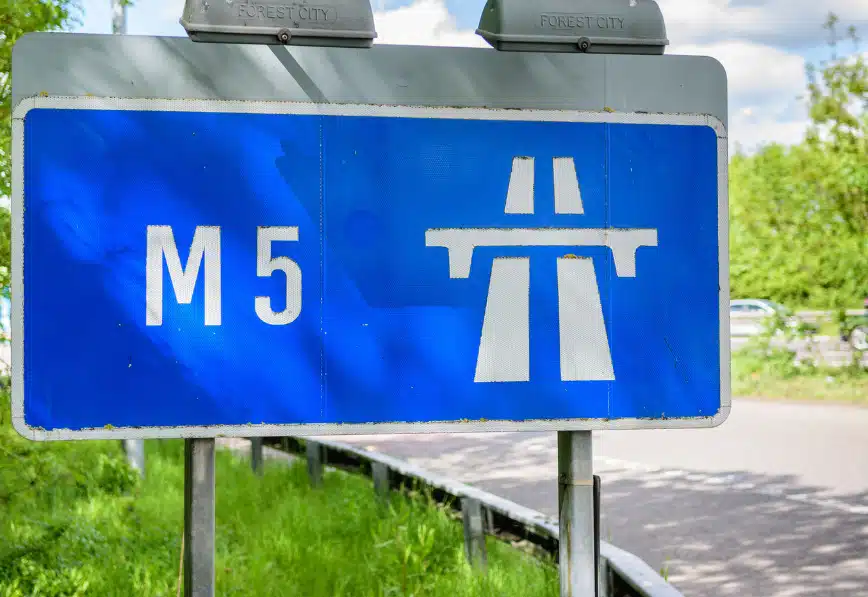
What Does the Start of Motorway Sign Mean?
The blue motorway symbol marks the point where motorway regulations begin. From this sign onwards, drivers must follow the rules that apply specifically to motorway traffic.
Motorways are designed for higher-speed traffic and are restricted to certain vehicles and road users. Learner drivers may use them only under the required supervision and vehicle conditions.
The sign may appear at the beginning of a motorway or on a slip road leading onto one.
Rules to Remember When Joining a Motorway
Before joining, use the slip road to build an appropriate speed, check mirrors and blind spots, and look for a safe gap in the traffic.
Traffic already on the motorway has priority, so joining drivers must adjust speed and position rather than forcing their way into a lane.
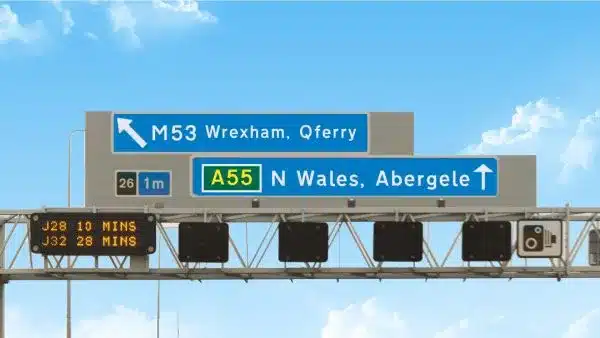
What Do Motorway Gantry Signs Mean?
Gantries display directions, junction information, speed limits, warnings and lane-control signals above the motorway.
Some signs apply to the whole carriageway, while signs positioned directly above individual lanes may give instructions for those specific lanes.
Check each gantry as you approach. Conditions can change quickly after congestion, a collision, roadworks or a stopped vehicle.
Common Motorway Gantry Signals
Look at both the symbol and the lane it is positioned above. Never copy another driver when the sign gives a clear instruction.
Speed Inside a Red Circle
This is a mandatory maximum speed limit. Reduce speed smoothly and do not exceed the displayed limit.
Red X
The lane below the signal is closed. Move safely into an open lane and do not continue beneath the Red X.
White Lane Arrow
Move into the lane indicated by the arrow when it is safe. The lane ahead may be closing or obstructed.
Speed Without a Red Circle
This gives an advised maximum speed for the conditions ahead. Reduce speed and be prepared for a hazard.
End of Restriction
The temporary lane or speed restriction has ended. Continue to follow any other signs and the normal speed limit.
Hazard Warning
Electronic signs may warn of fog, ice, queues, debris, roadworks or an incident ahead.
Never Drive Under a Red X
A Red X is not simply a warning that a lane may close later. It means the lane is already closed to traffic.
There may be a stopped vehicle, collision, debris, road worker or another danger beyond the signal, even when you cannot see it yet.
What Do Motorway Countdown Markers Mean?
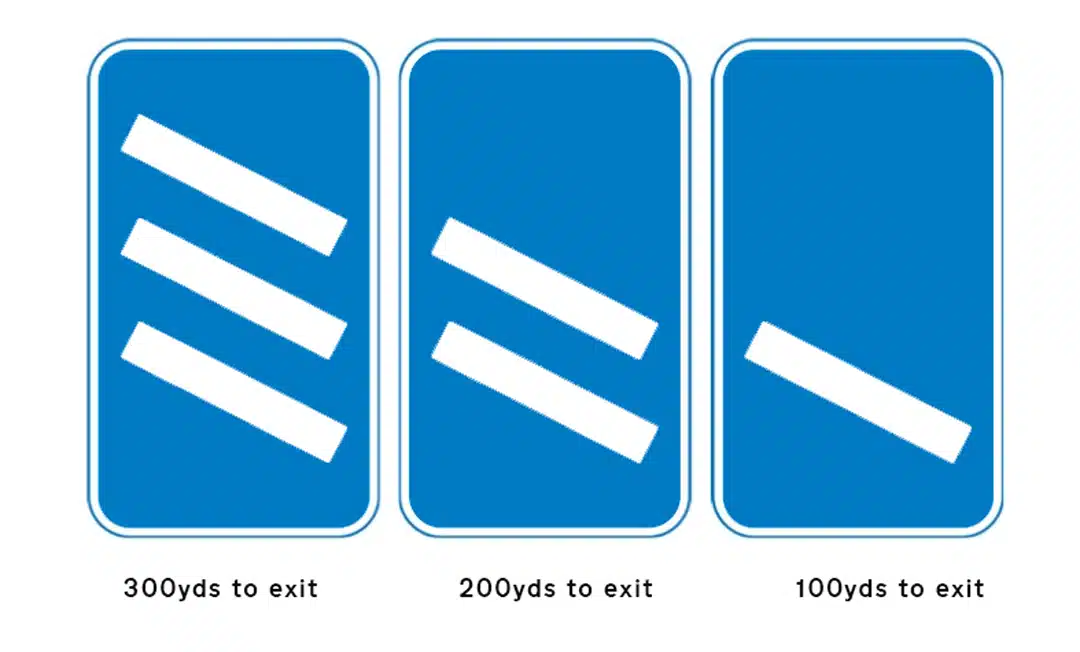
Countdown markers appear before many motorway exits. They help drivers judge how far remains before the start of the exit slip road.
The first marker has three white bars, the second has two and the last has one. Each bar represents approximately 100 yards.
Use the markers to confirm your position, check mirrors and prepare to move into the correct lane without making a rushed last-second change.
How the Countdown Sequence Works
The bars count down towards the beginning of the deceleration lane, not necessarily the point where the road leaves the motorway completely.
Three Bars
Approximately 300 yardsCheck mirrors, confirm the junction and begin preparing for the exit.
Two Bars
Approximately 200 yardsMake sure you are positioned correctly and signal when appropriate.
One Bar
Approximately 100 yardsThe exit lane is close. Avoid sudden braking or cutting across lanes.
How Should You Approach a Motorway Exit?
Read the advance direction signs, move into the correct lane in good time and keep a safe following distance.
Avoid reducing speed sharply while still in the main traffic lane. Where conditions allow, move into the slip road before slowing for the junction ahead.
What Is a Motorway Location Sign?
Driver location signs are small blue signs positioned at regular intervals beside many motorways and some major roads.
They provide a precise reference that can help motorway operators, recovery services and emergency services locate a breakdown or incident quickly.
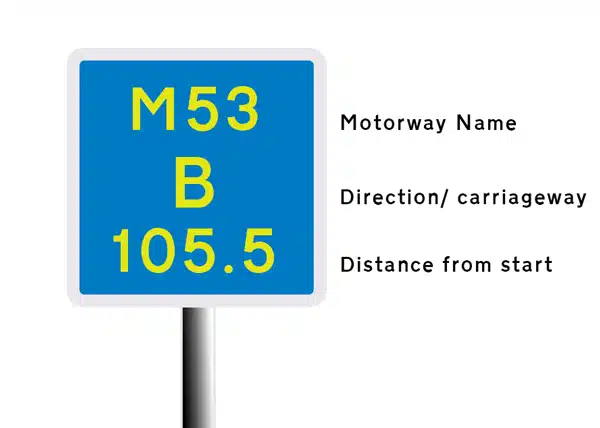
The sign normally contains the road number, a carriageway identifier and a unique location reference.
How Do You Read a Motorway Location Sign?
Give all three parts of the sign when reporting an emergency. Together, they identify the road, direction of travel and exact location.
Motorway Number
The top line identifies the motorway or road you are travelling on.
Carriageway Identifier
The letter identifies the carriageway or section of road. Report it exactly as it appears rather than trying to describe the direction yourself.
Location Reference
The final number provides a unique reference for your position along that motorway.
What Should You Report in an Emergency?
When it is safe, read the complete location sign to the emergency service, motorway control centre or breakdown provider.
Do not give only the motorway number. The carriageway letter and location reference help distinguish your position from the opposite side or another section of the road.
Road, Carriageway, Location
Remember the sign as three layers: which road you are on, which carriageway you are using and where you are along that road.
What Colours Are Used on Motorway Signs?
The background colour, border and symbol style help drivers recognise the type of information being given.
Blue Signs
Blue signs are commonly used for motorway directions, route information and motorway regulations.
Red Circles
A red circle normally gives a mandatory restriction, such as a maximum speed limit.
Red Triangles
Triangular signs with red borders warn drivers about hazards ahead.
Brown Signs
Brown signs direct drivers towards tourist attractions and visitor destinations.
Why Are Motorway Junction Numbers Important?
Junction numbers make route planning much easier. They help drivers identify where to leave the motorway and confirm that the correct exit is approaching.
Navigation systems may give both a destination and a junction number, so checking both reduces the chance of taking the wrong exit.
Common Motorway Sign Theory-Test Mistakes
Many questions are designed to test whether you understand the precise meaning of a sign rather than simply recognising its shape.
Ignoring the Red Circle
A speed inside a red circle is mandatory. A speed shown without one may be advisory.
Treating a Red X as Advice
A Red X means the lane is closed. It is not an instruction to move only when convenient.
Misreading Countdown Bars
Three bars mean approximately 300 yards, two mean 200 and one means 100 yards.
Braking Too Early for an Exit
Where conditions allow, move into the slip road before reducing speed sharply.
Missing the Lane-Specific Signal
A signal above one lane may apply only to that lane, so check where it is positioned.
Giving an Incomplete Location
Read the road number, carriageway identifier and location reference from a driver location sign.
Motorway Sign FAQs
What colour are motorway direction signs?
Motorway direction signs normally have a blue background with white lettering and symbols.
What does the motorway symbol mean?
The motorway symbol marks the point where motorway regulations begin or identifies a route leading onto a motorway.
What does a Red X mean?
A Red X means the lane below it is closed. Move into an open lane as soon as it is safe and do not drive beneath the signal.
Are motorway gantry speed limits compulsory?
A speed displayed inside a red circle is a mandatory maximum speed limit.
What do motorway countdown markers mean?
The markers count down towards the start of an exit slip road. Three bars mean approximately 300 yards, two mean 200 yards and one means 100 yards.
What information is shown on a motorway location sign?
A motorway location sign normally shows the road number, a carriageway identifier and a unique location reference.
What should I do if I miss my motorway exit?
Continue to the next junction. Never stop, reverse or cut across lanes to reach a missed exit.
Can learner drivers drive on motorways?
Learner drivers may use motorways in England, Scotland and Wales only when accompanied by an approved driving instructor in a dual-controlled car.
Prepare for Motorway Driving and Your Theory Test
Build your understanding of motorway signs, lane discipline, joining, leaving and changing traffic conditions with professional driving tuition.